Showing posts with label unschooling. Show all posts

Thursday, May 24, 2012

Lessons Learned talk notes (from Life is Good)

After attending five Life is Good Unschooling conferences with Bret and the girls, and leading lots of circle chats and funshops, I was excited and honored to be one of the main presenters at this year's conference.  My topic was "Lessons Learned" and in it I shared how we came to unschooling, some thoughts about unschooling food, some of our favorite books, toys and crafting supplies, unschooling tv, and finishing with the top 10 lessons we've learned along the way.  Recordings of all of the conference talks will be available to purchase through the Unschooler's Emporium after the conference concludes.  I mentioned in the talk that I would post the books and toys I mentioned here on the blog, in case anyone wanted to find them.  So here they are... 

Best toys/craft supplies:
Kapla blocks
Pattern Blocks (Discount School Supply (DSS) $15 for 250)
Other pattern toys:   
connectagons
dado cubes
magformers
widgets
“House of Cards”
Big chalk board
Colored masking tape (DSS - $29)
Die cut machine (Sizzix Big Kick – look for the 40% off coupon in your Sunday paper for Joann's or Michaels)
Hot glue guns
Glue stick trick -- use old phone books when you are doing glue projects – can get glue on the phone book page, then rip it out and have a new clean surface
Wiki Sticks (great for airplane trips, as they stick to the backs of seats or windows)
Legos (but first put a sheet or big cloth below them so you can easily pick them up
Dress up clothes 
Doctor kit
Face paint and washable markers
Paper shredder
Puzzles – especially like the GeoPuzzles – also read a great post by Sandra Dodd about how if you buy used puzzled and they’re missing a few pieces, so what?  They're still fun! 
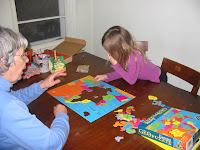
Of course, board and card games, but there are just too many to list here...

Jan Hunt's Parenting Cards (pick a sample card -- “Children like kittens.”) 
Toys don’t have to cost a lot…Wired magazine – top 5 toys of all time:
string
stick
box
tube
dirt

Some of our favorite books are:

Jan Hunt’s The Natural Child:  Parenting from the Heart

 As Peggy O’Mara (from Mothering Magazine) says in the introduction “We ask how we can maintain order and harmony in the household without control, without punishment.  As Jan will so aptly teach, the household based on empathy, compassion and cooperation will have an inherent discipline that does not have to be enforced by punishment.  It is enforced by love.”


If you have littles, I can’t recommend this one enough:  Things to do With Toddlers and Twos (and More TTDWTAT).  They’re written by Karen Miller, originally published in the early 80s.  Tons of inexpensive ideas for sensory learning using things most people have around their houses. 


If you have slightly older kids, 101 Places You Gotta See Before You’re 12 is a great resource for discovering the world around us.  Instead of listing specific places, it asks kids to visit places like a battlefield, backstage of a theater, an old folks home. 

Sandra Dodd’s books  (Moving a Puddle, which is a collection of essays, and the Big Book of Unschooling) and webpages.  I especially like her Just Add Light and Stir blog  – as it has very short daily reminders of ways to move towards unschooling, and a more peaceful family life.   I also like that she has quotes from lots of other experienced unschoolers, so you get to hear how different families have dealt with a variety of topics.

Another favorite book is Rue Kream’s Parenting a Free Child:  An Unschooled Life.  The question & answer format of the book makes it a really handy reference guide when you’re thinking about (or your in-laws are bugging you about) such questions as:  How do you ensure that your kids eat properly? Or Do you just let your kids do whatever they want?  Or Aren’t you afraid there will be gaps in your kids’ knowledge? 

Freedom Not License by A.S. Neill (who founded the Summerhill free school) is a little dated, but also has a Q&A format that makes it easy to find info on specific questions.  I love his concept that children (and we all!) should be able to make our own choices as long as they don’t negatively impact others around them.  His example is that at his school a child is free to go to lessons or stay away from them because that’s his own affair, but he’s not allowed to play a trumpet while others want to study or sleep. 

It ties in nicely with the idea that unschooling is not unparenting – it actually means being very involved with our kids and partnering with them.  To me, the concept of freedom, not license doesn’t mean that we let our kids run wild and do anything they want to do, but we help them learn how the world works, allowing them as much freedom as possible while not infringing on the rights of others.

Of course, read anything you can by John Holt – though if you’re just starting out I’d recommend  Learning All the Time.  It’s short! And it covers topics new unschoolers are frequently concerned about – such as how kids learn to read and write.

The book Imagine (Jonah Lehrer) I haven’t read his book yet, but I recently heard the author speaking about how ideas don't just magically happen, they come from making connections between things that haven't been there before.  With this in mind, I talked about using everyday objects or toys in new ways:

Playmobile with Playdough

 Canoe as wading pool
Canoe as clubhouse
Cooler as hot tub
Fishing pole as kite flyer
Umbrella, parachute and paddles as tent
Spelling with kapla blocks
Beds for jumping

 Finally, a quote from The Tao of Parenting by William Martin.  It says:
         
          It has been said by experts,
          “You must be consistent,
          or your children will be confused.”
          Nonsense.
          Who among us is consistent?
          Circumstances are always changing.
         
          Children become confused
          When parents become rigid,
          Holding rules above love.
          Be consistently flexible.
          Hold tight only to compassion.

Friday, January 14, 2011

I was homeschooled

Well, I wasn't...but my girls are, and the author of this article was (thanks, Grandmother Joan for calling to tell us about it!). One of my favorite points she makes is also about why we homeschool:

When I asked my mom why she decided to homeschool my brothers and I, she said, "I liked being around you." People expect a massive critique of society, which she can also do, when she feels like it. But underneath that is something much more straightforward.

I think that people want homeschooling to be incredibly complicated because school has become incredibly complicated. Education has become a messy, chaotic topic that we, as a nation, can't stop talking about. "Waiting for Superman", budget cuts, teen suicides, charter schools, healthier school lunches, colleges flooded with applications, student debt, student loans that go forever, elite preschools, KIPP, abstinence only sex ed, gay kids at prom, no child left behind, teachers' unions, rubber rooms, standardized testing, teacher suicides, cutting music and art classes, where it all is going, what we might be able to do, whether we should do it, and if it really works at all.
As Bret and I both have lots of experiences in public schools (as students, a librarian, student teaching and as coaches), and have many friends who are currently teachers, we know how hard it is...it is complicated because of the sheer size of schools/school districts. There's nothing better than having a teacher:student ratio of 1:1 (even though I'm home full time with the girls, I feel that they "learn" as much from me as they do from Bret...and we learn from them!). Or even if you look at it as a teacher:student ratio of 1:2, it's still pretty darn good.

While there are days when I long to just run a few errands solo, or feel that I am giving up a lot to stay home, in the "big picture" I know that this time will go quickly, and they will be grown up...knowing their parents well...all too soon!

The author of the above mentioned article also also writes at: unschooled.net, eat the damn cake (heck yeah!) and the Huffington Post.

Wednesday, April 21, 2010

Tuesday, April 20, 2010

Just in case anyone watched...

...the (IMHO) awful piece Good Morning America did on unschooling, (I'm reluctant to even link to it as the interviewer was so obviously biased against unschooling but hey, maybe she's just going for controversy to get ratings...) here's a great response from the Huffington Post.

Monday, October 19, 2009

Great post from a list I'm on

Apparently I've become a once or twice a month blogger...really, I hope to start posting more frequently, but we've just been doing other stuff!

I did want to share this post from the Unschooling Basics Yahoo Group. A parent was asking about how unschooled kids learn anything...but especially subjects like math. The response is from from Joyce Fetteroll whose webpage has a wealth of information on unschooling. (If you're reading, thanks for giving me permission to post this, Joyce!)

***

To add to Meredith's great post, I think when nonunschoolers read
about what unschoolers do it sounds like we're trying to impose some
airy fairy theory on kids, denying them the hard but good-for-them
medicine of disciplined learning and replacing it with something
gentle and nice, but that, from the outside, looks totally
ineffective. Unschooling seems to be a way of avoiding being mean to
the kids but will ultimately leave them unlearned.

[emphasis mine] But the truth is that what kids learn in school is *made* hard to learn. Not because educators are mean ;-) but because they need to demonstrate that specific learning is taking place. In order to prove learning, they are limited in the methods that yield something testable. Unfortunately the natural way we -- and all animals -- learn is scatter shot. We pick up bits and pieces here and there as we need them. We naturally learn to grow our understanding. It's very very hard to test for understanding (especially since we don't approach understanding linearly). (And very very hard to grade!) That's why most tests test for what's been memorized.

Learning is sort of like assembling a jigsaw puzzle. We naturally
work on the areas that interest us that expand and grow to meet up
with other areas of interest. And we jump around. At first the puzzle
often just looks like bigger pieces of chaos. ;-)

In school, the kids are told what they're going to make and told to
find the corner piece and place it in the corner. Then the next piece
that attaches to it. Then the next piece that attaches to it.

If the two puzzles were tested against school standards: how many of
the upper left is done, the schooled puzzle worker might have a
several dozen pieces in the corner. The natural puzzle worker might
have two. But what would be missed by a standardized test is all the
*other* pieces the natural puzzle worker had assembled. And, while
the schooled puzzle assembler might test well, they aren't learning
ways to tackle a jigsaw puzzle. They *look* like they're
accomplishing something, but what they're learning is that doing
puzzles is hard and boring and pointless and left on their own it's
unlikely they'll finish it. The natural puzzle worker doesn't look
like they're accomplishing anything (judging by their progress in the
corner since that's *all* a standardized test can test) but they're
having fun and the real accomplishment is happening far from the
testing area. And if they enjoy it, they're likely to do many puzzles
in their life.

School is to natural learning as Spanish class is to picking up
language as a child. One is hard and pretty much ineffective after
class is done. The other is effortless and effective. The second is
so effortless that we don't even take it seriously. We just know it's
something mysterious that happens and has no relationship to anything
else.

But it does! That's how we are designed to learn! It's messy. Chaotic
natural learning is very frustrating for someone who wants feedback
that specific learning is taking place. If there had been a
standardized test of language acquisition in 18 month olds, a typical
question would be pronouncing their name. My daughter would have
failed. A standardized test would *not* have asked how many dinosaur
names she knew ;-) (She had a shirt with 9 dinosaurs on it which she
could rattle off. She could say pachycephalosaurus before she could
say Kathryn ;-)

I'm betting that unless you're a history buff, that you've forgotten
way more history than you remember! The political doings of dead
white guys is really dull for most people. What most people find
interesting is bits of history of whatever interests them, social
history, how people lived in the past (movies and books are good for
that). As the build up that jigsaw puzzle, it eventually connects to
bits and pieces of political history.

My daughter probably knows more about early 1900s America than I do
because she's been fascinated by early baseball and has read several
books about it. One of her favorite guitarists was dressed as a
gangster in a video and that sparked an interest in gangsters. We're
reading a book about gangsters in film and it's starting way back
with the beginning of real gangsters and prohibition and the politics
surrounding it.

Is that the same as slogging through a history course? Absolutely
not. In some ways it's inferior since it doesn't cover the
"important" stuff. But how much of the "important" stuff do most
people remember? In many ways it's superior. My daughter really knows
the information she's read about early baseball. She hasn't just
memorized it. She knows the whys and wherefores. She knows some of
the social and political history that influenced what happened.
That's a foundation she'll build on throughout life.

The thing is educators get to say "We did our job. We put the
information in there. Not our fault if they don't remember it 10
years later." But *shouldn't* part of their job to be to make those
12 years time well spent? The "Are You Smarter Than a Fifth Grader"
is pretty telling. But it doesn't tell what it supposedly does: that
5th graders are smarter than adults. It says that great huge chunks
of that stuff you put up with learning for 12 years is going to be
gone by the time you're an adult.

Yet how many adults can still recite the theme song to Gilligan's
Island? ;-) Some think it means we're naturally drawn to trivial
entertainment and must be made to learn the hard stuff. No, what it
really means is that if it's fun and *personally meaningful* we'll
remember.

> I mean, how will the kids learn math? You know, adding,
> subtracting, multiplication?? What about language? How will they
> know what to capitalize or the correct punctuation?
>

I know, it's hard to imagine. But they do. We are natural puzzle
solvers. We want to understand how things work. We want to master
what we enjoy. We don't necessarily want to know how things work on
someone else's schedule, though!

Just because an unschooled kid might not be using standard
punctuation and capitalization when schooled kids are doesn't mean
they don't care. It means it's not important to them. Yet. Mostly
kids are writing for themselves. *At that age* they don't need to
communicate to someone else so all that's important to them is
getting the thoughts down onto paper or screen. (It might be a story.
It might be a label.) Translating thoughts to words is important part
of writing. (And the part that's hard to test! Testing grammar and
punctuation is easy and why its made more important in school than it
really is.) Later, when they're communicating with others (and trying
to read others' communications) on message boards and email and so
on, they'll feel the difference between standard grammar and
creative. Reading a novel in chat speak might be interesting once but
it would be pretty obvious how limiting it is for meatier
communication! ;-) (But writing out thoughts formally on a text
screen is equally limiting! Each has their uses.)

It's really really really hard to imagine how kids can learn math
merely by using it. As an engineer I was certain you couldn't learn
math without hours and hours of practice. I was wrong. I didn't learn
math so much as practice applying formulas. I didn't really
understand what lay beneath the formulas because it was obscured by
the tedium of getting the precise answer to the 3rd decimal point. My
daughter, though, understands *how* numbers work. She understands
their fluid nature and how they're manipulated. The notation just
formalizes what she intuitively understands.

I've written a fair amount about math and reading and grammar (and
lots on chores!) at:
http://joyfullyrejoycing.com/

Also two articles that might help you understand why school makes so
much sense and why it's so hard to grasp why unschooling is better are:

Products of Education
http://sandradodd.com/joyce/products

Why You Can't Let Go
http://sandradodd.com/joyce/talk

Joyce

Tuesday, April 28, 2009

We're saving the world!

Love this article...it's from a Canadian, eh? Read the whole thing here.

Unschooling, by contrast, starts with the realization that you 'own' your time, and have the opportunity and responsibility to use it in ways that are meaningful and stimulating for you. When you have this opportunity, you just naturally learn a great deal, about things you care about, things that will inevitably be useful to you in making a life and a living. Your learning environment is the whole world, and you learn what and when you want, undirected by curricula, textbooks, alarm clocks and school bells. You develop deep peer relationships around areas of common interest, once you're allowed to explore and discover what those areas of interest are. And the Internet and online gaming allow you to make those relationships anywhere in the world, to draw on the brightest experts on the planet, and to communicate powerfully with like-minded, curious people of every age, culture and ideology.

Wednesday, December 3, 2008

How to be a good unschooler

This is written by Pam Sorooshian and can be found here. I was going to just post one or two paragraphs, but I couldn't choose which ones I liked the best. They're all good. I'm also posting it so I can go back to it and remember these things on days when I need it.

1. Give your love generously and criticism sparingly. Be your children's partner. Support them and respect them. Never belittle them or their interests, no matter how superficial, unimportant, or even misguided their interests may seem to you. Be a guide, not a dictator. Shine a light ahead for them, and lend them a hand, but don't drag or push them. You WILL sometimes despair when your vision of what your child ought to be bangs up against the reality that they are their own person. But that same reality can also give you great joy if you learn not to cling to your own preconceived notions and expectations.

2. Homeschooled children who grow up in a stimulating and enriched environment surrounded by family and friends who are generally interested and interesting, will learn all kinds of things and repeatedly surprise you with what they know. If they are supported in following their own passions, they will build strengths upon strengths and excel in their own ways whether that is academic, artistic, athletic, interpersonal, or whichever direction that particular child develops. One thing leads to another. A passion for playing in the dirt at six can become a passion for protecting the natural environment at 16 and a career as a forest ranger as an adult. You just never ever know where those childhood interests will eventually lead. Be careful not to squash them; instead, nurture them.

3. Bring the world to your children and your children to the world. Revel in what brings you together as a family. Watch tv and movies and listen to music and the radio. Laugh together, cry together, be shocked together. Analyze and critique and think together about what you experience. Notice what your child loves and offer more of it, not less. What IS it about particular shows that engage your child—build on that. Don't operate out of fear. Think for yourself and about your own real child. Don't be swayed by pseudostudies done on school children.

4. Surround your child with text of all kinds and he/she will learn to read. Read to them, read in front of them, help them, don't push them. Children allowed to learn on their own timetable do learn to read at widely divergent times—there is NO right time for all children. Some learn to read at three years old and others at 12 or even older. It doesn't matter. Children who are not yet reading are STILL learning—support their learning in their own way. Pushing children to try to learn to read before they are developmentally ready is probably a major cause of long-term antipathy toward reading, at best, and reading disabilities, at worst.

5. It doesn't matter when something is learned. It is perfectly all right for a person to learn all about dinosaurs when they are 40 years old, they don't have to learn it when they are nine. It is perfectly all right to learn to do long division at 16 years old, they do not have to learn that at nine, either. It does not get more difficult to learn most things later; it gets easier.

6. Don't worry about how fast or slow they are learning. Don't test them to see if they are "up to speed." If you nurture them in a supportive environment, your children will grow and learn at their own speed, and you can trust in that process. They are like seeds planted in good earth, watered and fertilized. You don't keep digging up the seeds to see if the roots are growing—that disrupts the natural growing process. Trust your children in the same way you trust seeds to sprout and seedlings to develop into strong and healthy plants.

7. Think about what is REALLY important and keep that always in the forefront of your interactions with your children. What values do you hope to pass on to them? You can't "pass on" something you don't exemplify yourself. Treat them the way you want them to treat others. Do you want respect? Be respectful. Do you want responsibility from them? Be responsible. Think of how you look to them, from their perspective. Do you order them around? Is that respectful? Do you say, "I'll be just a minute" and then take 20 more minutes talking to a friend while the children wait? Is that responsible? Focus more on your own behavior than on theirs. It'll pay off bigger.

8. Let kids learn. Don't protect them or control them so much that they don't get needed experience. But, don't use the excuse of "natural consequences" to teach them a lesson. Instead, exemplify kindness and consideration. If you see a toy left lying in the driveway, don't leave it there to be run over, pick it up and set it aside because that is the kind and considerate thing to do and because kindness and consideration are values you want to pass on to your kids. Natural consequences will happen, they are inevitable. But it isn't "natural" anymore if you could have prevented it, but chose not to do so.

9. We can't always fix everything for our kids or save them from every hurt. It can be a delicate balancing act—when should we intervene, when should we stay out of the way? Empathy goes a long long way and may often be all your child needs or wants. Be available to offer more, but let your child be your guide. Maybe your child wants guidance, ideas, support, or intervention. Maybe not. Sometimes the best thing you can offer is distraction.

10. Be sensitive to your child's interest level. Don't push activities that your child isn't interested in pursuing. Don't let YOUR interests dictate your child's opportunities. If your child wants a pet, be realistic and don't demand promises that the child will take sole care for it. Plan to care for it yourself when the interest wanes. Do it cheerfully. Model the joy of caring for animals. Model kindness and helpfulness. Help a child by organizing their toys so they are easy to care for. Plan to care for them yourself much of the time, but invite your child's help in ways that are appealing. If YOU act like you hate organizing and cleaning, why would your child want to do it? Always openly enjoy the results of caring for your possessions—take note of the extra space to play in, the ease of finding things you want, how nice it is to reach into a cupboard and find clean dishes. Enjoy housework together and don't make it a battle.

11. Don't pass on your own fears and hates about learning anything. If you hate or fear math, keep it to yourself. Act like it is the most fun thing in the world. Cuddle up and do math in the same way you cuddle up and read together. Play games, make it fun. If you can't keep your own negativity at bay, at least try to do no harm by staying out of it.

12. Don't try to "make kids think." They WILL think, you don't have to make them. Don't use every opportunity to force them to learn something. They WILL learn something at every opportunity, you don't have to force it. Don't answer a question by telling them to "look it up" or by asking them another question. If you know the answer, give it. If you don't, then HELP them find it. Speculating about an answer often leads to a good conversation. If your child stops seeing you as helpful when they have questions, they'll stop coming to you with their questions. Is that what you really want?

13. When you offer a child choices, be sure they are real choices. Offer them choices as often as you can. Try to limit the "have to's" as much as you can. Frequently ask yourself, "Is this really a "have to" situation or can we find some choices here?"

Tuesday, January 22, 2008

Tapestree table


It's a big hit...so glad we got to see this at LIFE is Good last year, and thanks to Granny Jean and Boopy for the Christmas gift.
Posted by Picasa

Thursday, October 4, 2007

Unschooling article

Just read this interesting article from Tulsa, which features a family with now mostly grown unschoolers, and a family with all the kids still at home. I particularly liked the following part [emphasis mine] where an associate professor of education says that kids don't naturally want to learn, and John Holt's views on that subject:
“I think it would be a wonderful way to be schooled,” says Dr. Diane Beals, associate professor of education at the University of Tulsa. “But it takes a great deal of thought and planning. It would work for kids who are curious and highly motivated, and parents who are highly motivated and have a deep understanding of the fields of knowledge they are trying to teach their children. But, there are a lot of kids who just naturally don’t want to learn anything academic. The basic assumption is that kids do want to learn. I don’t think you can say that about all kids everywhere.

John Holt believed that all children are hard wired to learn. “This idea that children won’t learn without outside reward or penalties…usually becomes a self-fulfilling prophecy,” wrote Holt in his book, How Children Fail. “So many people have said to me, ‘If we didn’t make children do things, they wouldn’t do anything.’ Even worse, they say, ‘If I weren’t made to do things, I wouldn’t do anything.’ It is the creed of a slave. When people say that terrible thing about themselves, I say, ‘You may believe that, but I don’t believe it. You didn’t feel that way about yourself when you were little. Who taught you to feel that way?’ To a large degree, it was school.”